
After consumer price index jumped the 6.3-per cent mark in May and wholesale inflation set a record of 12.94 per cent, house economists at Swiss brokerage UBS Securities have warned that the country is facing more upside risks on the inflation front that is set to averaging at 5 per cent for the year. Rising prices of edible oils and protein rich items pushed retail inflation to a six-month high of 6.3 per cent in May, breaching the comfort level of the Reserve Bank and thus rendering reduction in interest rates a difficult proposition in the near term. Led by petrol price, that has crossed the Rs 100-mark in many states, wholesale inflation too accelerated to a record 12.94 per cent in May. While crude oil has crossed $70 a barrel on account of rising prices of crude oil and manufactured goods due to spike in commodities, and the low base of last year due to the lockdown.

In case of onions, inflation skyrocketed to 127.04 per cent, while for the eggs, meat and fish segment the rate of price rise was 5.76 per cent.

As India looks to mend its Covid-battered economy, one thing that will grab the attention of all concerned is the path that both wholesale and retail inflation will follow. Even the Reserve Bank of India in its latest policy statement said, "Going forward, the inflation trajectory is likely to be shaped by uncertainties impinging on the upside and the downside.

Inflation has zoomed to a three-year high of 7.41 per cent for the week ended March 29, against 7 per cent in the previous week.The wholesale price-based inflation, which stood at 7 per cent in the previous week, surged this time mainly on account of rising prices of fruits and vegetables, pulses, cereals, condiment and spices and some manufactured items.
Economic think-tank, Institute of Economic Growth said on Wednesday it expected widely tracked wholesale prices-based inflation to hover above 6 per cent for the present quarter.
Inflation rose to over nine-month high at 5.11 per cent for the week ended March 1, due to rise in prices of some manufactured items and aviation turbine fuel, dashing all hopes of interest rate cuts by the RBI to boost the sagging industrial production.The Wholesale Price Index-based Inflation rate stood at 5.02 per cent in the previous week and 6.51 per cent in the correspondingly week a year earlier.

Chief economic advisor Kaushik Basu on Thursday said that inflation may come down to 6 to 7 per cent in the next three months and that there was no need for any capital controls to check inflows as have been at a comfortable level.
For the first time after the government took drastic steps to rein in runaway price rise, inflation slipped to 7.14 per cent in the week ended April 5, 2008. In the previous week inflation had surged to a 40-month high of 7.41 per cent, mounting pressure on the Reserve Bank to further tighten money supply in its forthcoming annual credit policy later this month.
The move aimed at blunting Finance Ministry, RBI's opposition to monthly reporting.

Falling core inflation on the back of slowing economic growth is likely to create space for the Reserve Bank to ease monetary policy in the early part of the next year, rating agency Crisil said.

The Interim Budget for 2024-25 (FY25) to be presented on February 1 is likely to assume 10-10.5 per cent nominal gross domestic product (GDP) growth against 8.9 per cent estimated for FY24 by the National Statistical Office (NSO). "We were waiting for the First Advance Estimates GDP numbers for FY24. "We will finalise the nominal GDP growth assumption for FY25 Interim Budget in a couple of days.

The rate of price rise in food items, as calculated on the basis of the wholesale price index, was 8.53 per cent in the previous week and 21.46 per cent in the comparable period of 2010.

In its 'Asia Economic Alert', the banking and asset management behemoth also said that the Reserve Bank is likely to hike the short-term lending (repo) rate by 100 basis points in 2011 with the purpose of curbing inflationary pressure.

Wholesale price-based inflation remained below the psychological two-digit scores inching up marginally to 9.9 per cent in March from 9.89 per cent in the previous month.
The latest numbers are the lowest since December 2009 when headline inflation was at 7.15 per cent.
Concerned over surging prices, Finance Minister P Chidambaram said on Friday the government will not hesitate to take more fiscal and monetary measures to contain inflation.
Inflation galloped to 42-month high of 7.57 per cent for the week ended April 19 as compared to 7.33 per cent a week ago mainly on account of higher prices of food articles like rice, milk, tea, vegetables and some manufactured products.The wholesale price based inflation stood at 6.07 per cent in the corresponding week a year ago. The previous high of 7.76 per cent was recorded for the week ended November 2, 2004.

While the farmers are not getting remunerative prices for their produce, at the same time they are forced to pay high prices for items they consume.

The decline could also be attributed to the high inflation figure of 18.56 per cent for the corresponding year-ago period, a phenomenon dubbed the 'high base effect' in economic parlance.

The report said that weak global growth prospects have kept company prices in check in the international market and the same sentiments were being reflected in the domestic market. According to CMIE, prices of basic metal and metal products are projected to decline by 10.5 per cent in the current fiscal.
Reversing its very short upward trend, inflation fell by 0.23 per cent to touch about two-year low of 4.10 per cent for the week ended June 18 even as food items and manufactured products become costlier.

Unabated buying by domestic institutional investors and wholesale price inflation falling to 2.60 per cent in September, helped both the key indices to scale new highs.
The wholesale prices-based index stood at 4.72 per cent during the corresponding week previous year.

Total debt for listed Indian companies excluding financials fell only 4 per cent to $368 billion in the year ended in March 2015.
Food inflation fell sharply to a near four-year low of 1.81 per cent for the week ended December 10 as prices of essential items like vegetables, onion, potato and wheat declined.
The inflation which hit a high of 13 per cent in August following spike in prices of petroleum products in the international market, has been on the decline since the outbreak of the global financial crisis in mid-September last year.

The consumer price index has been in double digits for much of the past year, and was 9.8 per cent in September.

It can be closer to RBI's perceived comfort level.

The rapid deceleration in prices has ignited a debate in New Delhi whether Asia's third-largest economy is heading towards deflation.

The new wholesale price-based inflation basket will have as many as 676 products, including LCD TVs, mobile phones, and packaged drinking water among others, and is likely to be rolled out in June or July.

Benchmark indices Sensex and Nifty gave up early gains to close lower for a fourth straight session on Thursday due to selling in IT and banking shares amid weak global equities. The 30-share BSE benchmark settled 98 points or 0.18 per cent lower at 53,416.15. During the day, it hit a high of 53,861.28 and a low of 53,163.77. The broader NSE Nifty also pared initial gains and ended 28 points or 0.18 per cent down to settle at 15,938.65.
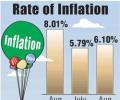
Costlier onion and other vegetables pushed up inflation for the third month in a row to 6.1 per cent in August, making it difficult for the RBI to cut rate in the monetary policy review due later this week.

8 out of 10 households are planning to cut their tomato consumption if prices stay in the Rs 75-150 kg range over the next three months.
The latest numbers are the lowest since December 2009 when headline inflation was at 7.15 per cent.

While SGBs are a sound investment, they aren't worth buying at any price. The interest income you earn from them will not justify paying a high premium.

The Bharatiya Janata Party notes with dismay the fact that the consumer price inflation in India today is the highest among all the countries of Asia-Pacific.
Inflation revised upwards to 7.91% for week ended July 24 from provisional level of 7.51%.
If the difference between provisional and final wholesale price index (WPI) numbers is taken as a leading indicator, the headline inflation rate, which is hovering around zero, is unlikely to change direction.

As it bets on a good monsoon for food prices to ease, the government on Tuesday said the Reserve Bank will consider appropriate policy actions to tighten money supply to bring down inflation.
 © 2026 Rediff.com - Advertise with us - Disclaimer - Privacy Policy - Sitemap - Feedback - About us - Terms of use - Grievances